Towards gender equitable urban mobility systems in Asia
By Sonal Shah, Founder, Urban Catalysts and Executive Director, Centre for Sustainable and Equitable Cities Transport is the fulcrum that can pivot women’s participation in the workforce, enable them to access opportunities and live fuller lives. However, transport systems in …
Charting a new path to decarbonised and climate resilient transport in Asia and the Pacific
By Jamie Leather, Chief of Transport Sector Group, Asian Development Bank For many years, the alarming rise in CO2 emissions from the transport sector has posed a significant threat to the planet, with Asia-Pacific bearing the brunt of this challenge. …
Tackling Transboundary Haze Pollution in Southeast Asia
By Dr. Supat Wangwongwatana, Air Pollution Expert, Faculty of Public, Thammasat University Senior Advisor, Thailand Environment Institute Since early 1990, transboundary haze pollution has been a recurring challenge which poses significant social, economic, and environmental impacts to the Association for …
The Green Revolution in Thailand Steering by Electric Buses
By Dr. Yossapong Laoonual and Dr. Kotchakarn Nantasaksiri, Mobility & Vehicle Technology Research Center (MOVE), King Mongkut’s University of Technology Thonburi, Thailand At the United Nations Climate Change Conference 2021 (COP26) in Glasgow, Scotland, Thailand’s Prime Minister pledged to reduce …
Advancing the Goals of the Paris Agreement through Regional Cooperation
By Wei-Shiuen Ng, United Nations Economic and Social Commission for Asia and the Pacific (ESCAP) Member States of the United Nations Economic and Social Commission for Asia and the Pacific (ESCAP) across the Asia Pacific region have shown different priorities …
Achieving a green energy transition in Vietnam’s transport sector through electric mobility
By Le Anh Tuan, Hanoi University of Science and Technology; Nguyen Thi Yen Lien, University of Transport and Communications and Dang Tuyet Ly, NDC Transport Initiative for Asia – GIZ An electric bus on the road in Hanoi, Vietnam. The …
Rebuilding China as the “Kingdom of Cycling” by Putting People and Planet First
By Daizong Liu, Xianyuan Zhu and Alphonse Tam, Institute for Transportation and Development Policy China In the 1980s, Chinese cities often had thousands of cyclists take to the streets during rush hour and the country was often recognised as a …
Cycling through a Range of Obstacles: Challenges in Pacific Island Countries
By Andrew Irvin, PhD Researcher & Project Officer, University of Melbourne, World Cycling Alliance Pacific Islands Countries (PICs) face many crises that demand urgent responses. PICs have some of the largest Exclusive Economic Zones and smallest land areas in the …
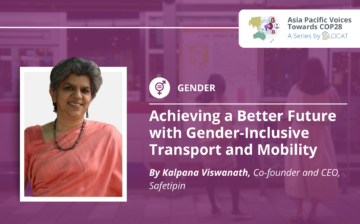
Achieving a Better Future with Gender-Inclusive Transport and Mobility
By Kalpana Viswanath, Co-founder and CEO, Safetipin Women occupy urban spaces and use transport systems in ways that are very different from men. This gendered experience is shaped by mainly two factors – women’s role as caregivers and safety concerns. …
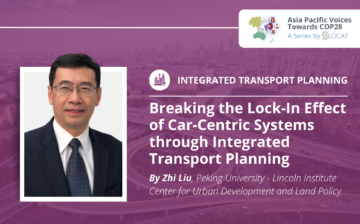
Breaking the Lock-In Effect of Car-Centric Systems through Integrated Transport Planning
By Zhi Liu, Senior Research Fellow and China Program Director, Lincoln Institute of Land Policy, and Director, Peking University—Lincoln Institute Center for Urban Development and Land Policy Integrated transport planning has been practised in many countries and regions around the …